Does a “Done Deal” Still Need Political Contributions
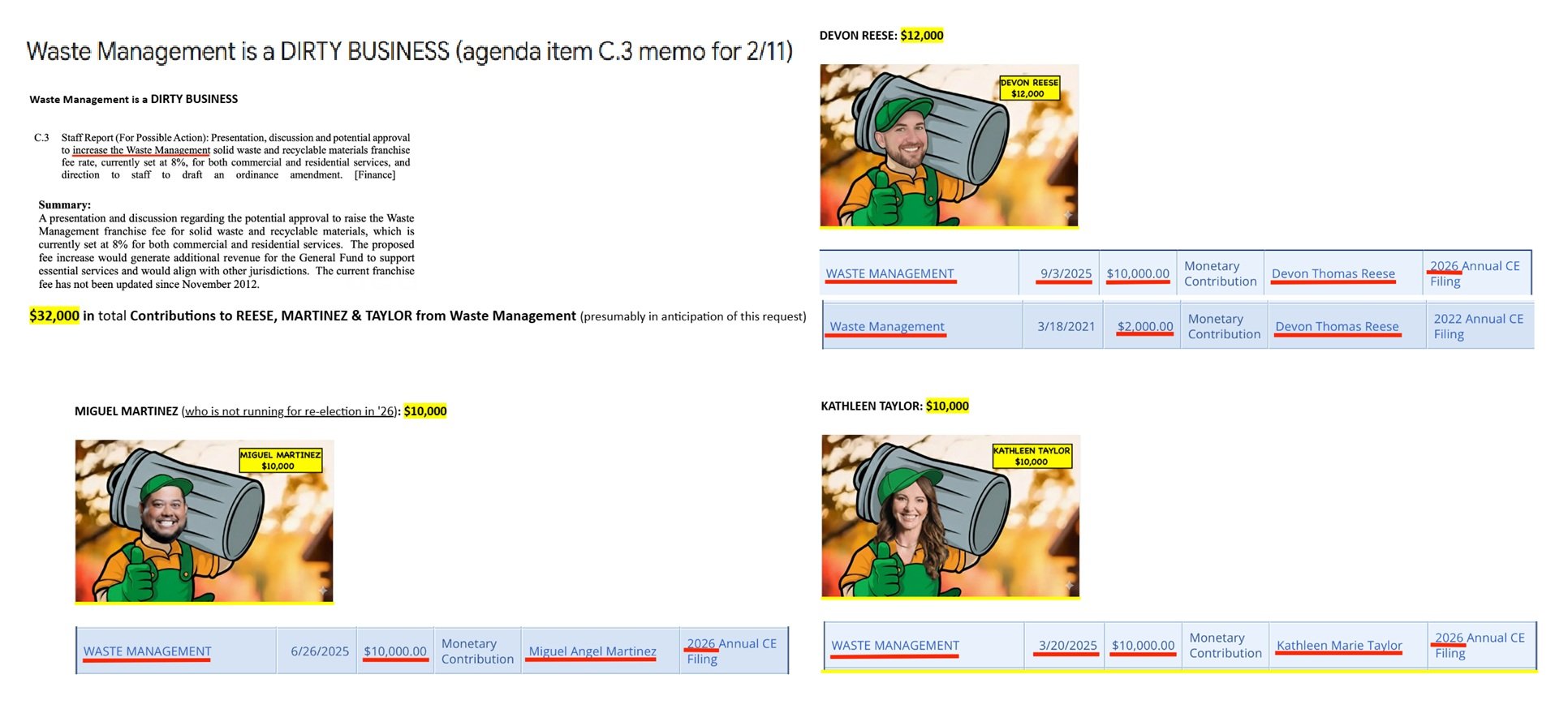
We always enjoy what our readers send to us. These meme’s are quite wonderful.
Picon is scratching its collective head over next week’s Reno City Council vote on increasing Waste Management’s franchise fee. Let’s be honest — at this stage most observers consider the fee increase a foregone conclusion. The logistics alone of transitioning an entire city’s waste system to a new provider would be a bureaucratic marathon, not a sprint. New trucks, new routes, new labor agreements, new infrastructure — it’s not something you flip like a light switch. Which is exactly why the timing of recent campaign contributions raises eyebrows.
Waste Management appears to be showing notable financial affection toward three Reno councilmembers elected in 2024 — all of whom are safely seated until 2028. In other words, there’s no immediate election pressure. Two of them, Taylor and Reese, are widely expected to have mayoral ambitions, so political positioning there at least follows a recognizable pattern. But the broader question remains: if this franchise fee increase is such a certainty, why the sudden generosity now?
The contrast becomes even more interesting when you look to the Rail City - Sparks. This very same month, Waste Management appeared on the Sparks City Council agenda for contract discussions — yet there was no comparable flurry of campaign contributions to be found. Public records show little to no recent giving in Sparks, with the last notable donations tracing back to pre-pandemic cycles. That naturally leads to the uncomfortable but inevitable political question: why Reno and not Sparks?
Sparks Mayor Ed Lawson and Councilmember Charlene Bybee are both running for mayor, making Sparks arguably just as politically relevant, if not more so, in the near term. So is Sparks less important to Waste Management, or is the calculus simply different? Political donations, after all, are rarely random acts of generosity; they’re strategic investments in relationships, access, and goodwill. The absence of those investments can be just as telling as their presence.
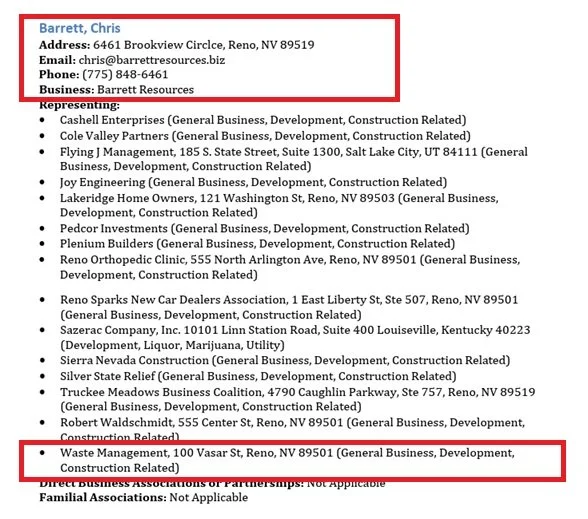
Then there’s the lobbyist layer — always the quiet subplot in municipal politics and murder mysteries. Barrett Resources appears on Reno’s lobbying lists and has also been a paid presence in Sparks government circles for years, you know that pesky lands bill. Lobbyists are, by definition, advisors on where to spend time, attention, and yes, money. Whether that guidance results in contribution checks or conspicuous restraint is part of the political chessboard most voters never see.
None of this suggests wrongdoing; campaign contributions are legal and common practice. But optics matter. When a franchise fee increase looks inevitable yet campaign accounts are being filled in one jurisdiction while another sees little to no activity, people notice. In politics, perception often travels faster than facts, and selective generosity tends to invite public curiosity.
At minimum, it’s an interesting case study in municipal strategy. At maximum, it’s a reminder that even the most “routine” contract renewals come wrapped in layers of timing, relationships, and political math. And sometimes the question isn’t just who’s giving — it’s who isn’t, and why.