
Did Paul White Say the Quiet Part Out Loud About the Cares Campus?
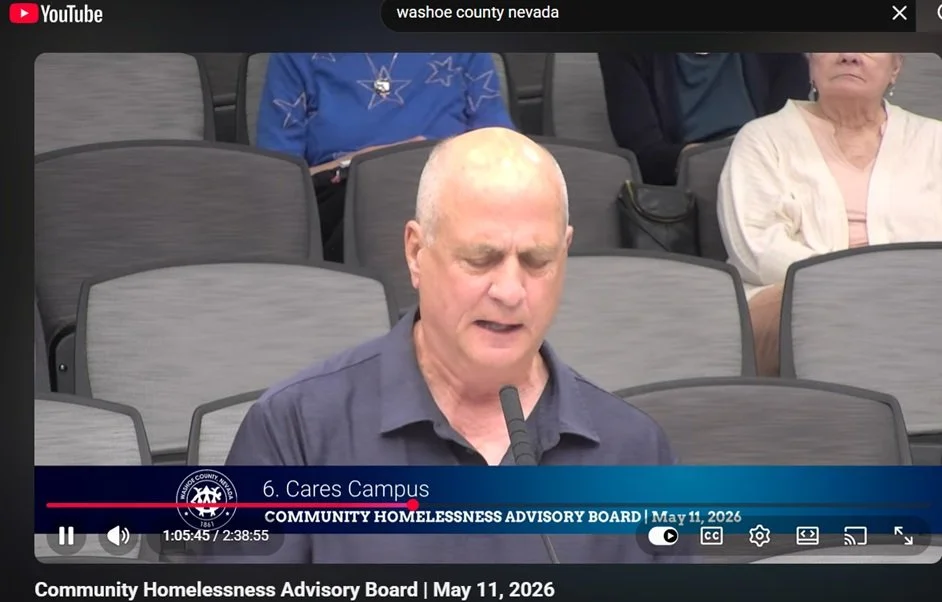
Paul White speaking at the CHAB - Community Homeless Advisory Board
Vagrants or Homeless? Paul White Asks the Question Washoe County Won’t …
At Monday’s CHAB meeting in Washoe County, Paul White presented his vision for taking over the Nevada Cares Campus with a coalition of churches and faith-based organizations.
Some of his ideas had merit. Some raised eyebrows. And one proposal — asking the county to deed taxpayer-funded land and buildings over to an unnamed coalition — seemed like quite the leap.
But since Picon apparently agreed with Jason Guinasso yesterday, perhaps hell really is freezing over, so maybe we should admit Paul White may have touched on a legitimate issue too.
The distinction White raised regarding the “guests” at the Cares Campus - It was vagrants versus homeless — and whether local government has stopped recognizing the difference. White questions how many “guests” are vagrants vs homeless.
That is a far more uncomfortable conversation.
Most people recognize homelessness can happen through job loss, medical crises, mental health struggles, domestic violence, addiction, or plain bad luck. Those individuals often want help, stability, housing, treatment, and a path back. And as White pointed out they tackle their difficulty and usually self-solve the problem.
But White’s argument appeared to be that there is another population — people who have embraced a transient, lawless, or chronically dependent lifestyle with little intention of changing behaviors regardless of services offered. In other words, vagrancy versus temporary homelessness.
And whether people like the terminology or not, many taxpayers increasingly believe there is a distinction.
That may explain why frustration surrounding the Cares Campus keeps growing despite massive spending, expanding services, and endless public funding requests. Residents see rising costs, ongoing public safety concerns, repeat offenders cycling through the system, and neighborhoods continuing to struggle. They are asking whether the current model is truly helping people recover — or merely managing street disorder at taxpayer expense.
Of course, drawing those distinctions is politically dangerous. The moment someone questions whether all homelessness is the same, they are accused by some of lacking compassion.
But avoiding the conversation does not solve the underlying problem.
Because public policy depends on accurately identifying what problem you are trying to solve. Emergency homelessness requires one set of solutions. Chronic addiction, untreated mental illness, criminal behavior, or entrenched vagrancy may require entirely different approaches involving accountability, treatment mandates, law enforcement, or structured intervention.
That does not mean taxpayers should simply sign over a publicly funded campus to private church groups. There are serious governance, transparency, and constitutional questions attached to that idea.
But White’s broader point may resonate with many residents who feel local leaders are afraid to acknowledge obvious realities playing out on the streets every day.
And until Washoe County clearly defines the mission of the Cares Campus — and who exactly it is designed to serve — taxpayers will continue questioning whether the current system is producing compassion, dependency, recovery, or simply more chaos. With the departure of Dana Searcy and the limited information the county had provided, two whistleblowers who are being overlooked and not addressed, our money is on chaos.