
When Local Reporting Becomes Part of the Conflict: The KUNR–Jacks Controversy
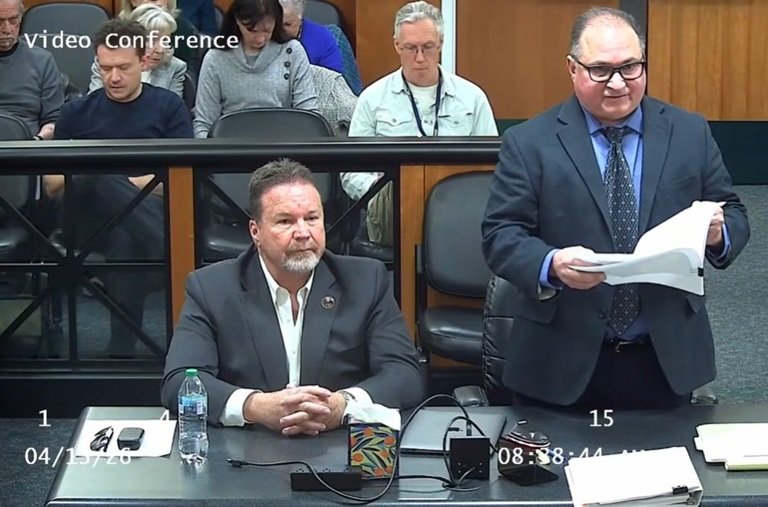
We ponder if Bert from KUNR who was covering the Leonard v Lorton hearing realized that Leonard’s attorney is also Gianna Jacks attorney. Bert is setting next to Greater Reno/RGJ/ Mark Robison. He is under Video Conference.
Public meetings rarely stay quiet in small communities, but the conflict involving Library Trustee Gianna Jacks, community members, and KUNR has moved beyond routine disagreement. What began as complaints voiced in local civic spaces has now evolved into a broader dispute involving allegations of harassment, claims of biased reporting, and a formal legal-style response directed at the media itself.
At the center of the controversy is reporting by KUNR that described concerns raised by two community members who said they had been harassed by Jacks. Those accounts were later amplified in public meetings, where residents echoed concerns about repeated communications and pressure to retract critical statements. The situation quickly became more than a disagreement over conduct—it became a debate over credibility.
Jacks, however, pushed back against that framing by issuing a Formal Notice and Demand Letter alleging ethical violations, factual errors, and biased reporting. That escalation signals a sharp divide not just over what happened, but over how it is being interpreted and presented to the public.
What makes this dispute especially significant for Reno residents is not simply the personalities involved, but the larger question it raises: when does reporting on conflict begin shaping the conflict itself?
According to accounts reported by KUNR and shared during public meetings, community members described repeated contact from Jacks following critical statements made about her conduct. These interactions were characterized by recipients as persistent and, in their view, inappropriate attempts to compel retraction of public comments.
One of the most contested aspects of the situation is interpretation. Supporters of the individuals raising complaints frame the repeated emails and mailed communications as a form of escalating pressure. In contrast, such actions could also be interpreted as an effort to defend reputation or correct what Jacks may believe are false or misleading statements.
This distinction matters because the boundary between assertive communication and harassment is not always clear. In civic disputes, especially those involving elected or appointed officials, reputational defense often overlaps with public accountability. The same behavior can be viewed differently depending on context, tone, and frequency.
The challenge for the public is that most of these exchanges occur outside full documentation. Without complete records of the communications, readers are left relying on summaries, testimony, and media framing—all of which influence perception as much as the underlying facts themselves.
The Formal Notice and Demand Letter issued by Jacks represents a significant escalation in the conflict. Such letters are typically used to challenge reporting, demand corrections, or formally allege reputational harm. They often signal that a subject believes journalism has crossed from coverage into misrepresentation.
In this case, the letter reportedly alleges ethical violations and factual errors in KUNR’s reporting, along with claims of bias. While the content of the letter is not fully detailed in public discussion, its existence alone raises important questions about how media outlets handle direct challenges to their work.
From a media ethics standpoint, demand letters do not automatically require a newsroom to change its reporting, but they do require review. Journalistic standards emphasize verification, balance, and responsiveness to credible disputes over facts. When those standards are met, outlets may stand by their reporting even in the face of formal objections.
However, the broader ethical question is not simply whether KUNR can stand by its reporting, but whether the reporting fully reflects the complexity of the situation. When one side of a dispute issues a formal challenge and the coverage remains largely unchanged, it can reinforce perceptions of imbalance—even if the reporting is factually defensible.
KUNR’s continued reporting after receiving the demand letter suggests confidence in its original journalism. News organizations often maintain their position when they believe their sourcing is reliable and their editorial process sound. From that perspective, standing firm can be seen as a defense of journalistic independence.
At the same time, persistence in framing can also create concerns about narrative rigidity. If coverage continues to emphasize one interpretation of events without equally revisiting the contested claims, audiences may perceive the reporting as fixed rather than evolving alongside new disputes.
Another issue raised by the situation is balance. Public-facing journalism in local communities carries heightened responsibility because readers often rely on a single primary outlet for civic information. If one perspective dominates the framing—especially in a conflict with reputational consequences—the ethical burden of completeness becomes more significant.
Even when a newsroom believes it has been accurate, the perception of fairness matters almost as much as factual precision. In small media markets like Reno, trust is built not only through reporting accuracy but also through transparency about uncertainty, disagreement, and unresolved claims.
Adding complexity to the situation is the response—or lack of response—from governing structures. During a public meeting referenced in the reporting, the outgoing board chair stated she was not aware of the issue, despite prior contact from the outlet. This disconnect raises questions about communication within oversight bodies.
At the same time, structural limitations in governance shape how disputes like this unfold. Library trustees, like many appointed officials, often operate within narrow legal frameworks that limit removal or disciplinary action. Even when concerns are raised publicly, formal mechanisms for resolution may be limited or slow-moving.
This structural gap creates a space where media coverage becomes the primary arena for accountability. When institutional processes are constrained, journalism often becomes the de facto investigator, interpreter, and public record keeper. That role carries significant influence—and significant risk.
For Reno residents, the core issue is not simply who is right in this dispute, but how truth is being constructed in real time. When media reporting, public testimony, and institutional silence intersect, the result is often a fragmented narrative where certainty is hard to establish and trust becomes increasingly difficult to maintain.
The controversy surrounding Gianna Jacks and KUNR ultimately reflects a broader tension in local democracy: the fragile balance between accountability and fairness, and the question of who gets to define where that balance lies.