
Unequal Protection? Reno Police Responses Raise Serious Questions
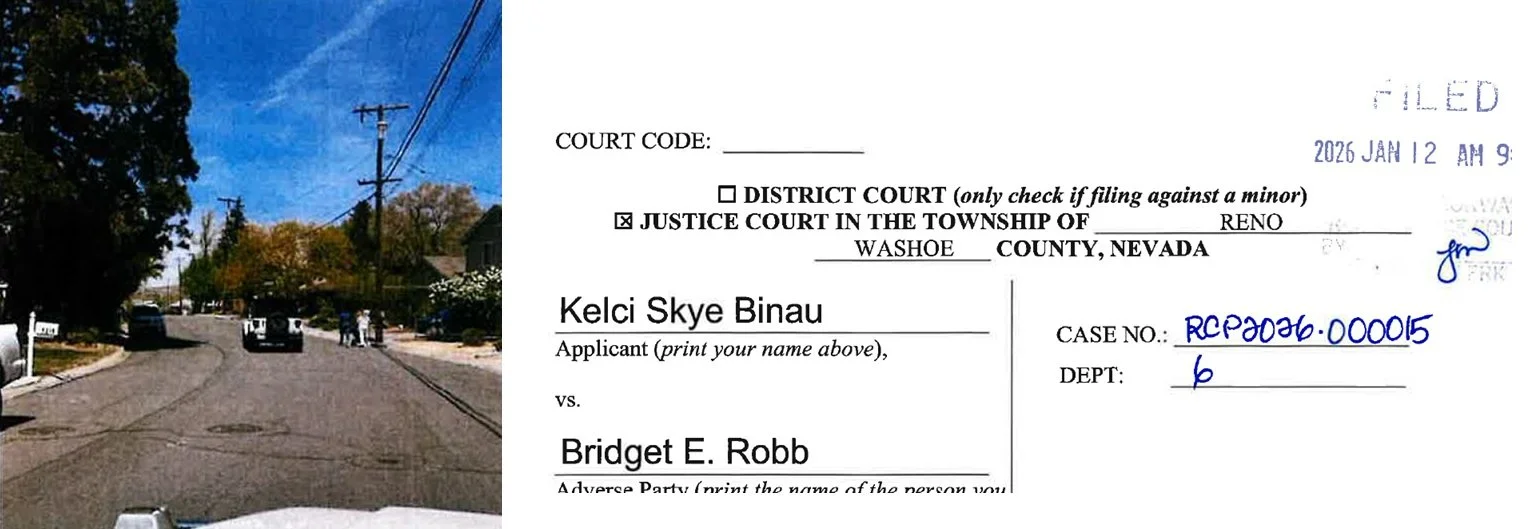
We have the entire temporary protection order claiming stalking against Judge Bridgett Robb who resigned today and announced she will not be running against Second Judicial District Department 10 Kathleen Sigurdson. The document is at the end of this article - we urge you to read it because it brings up more questions than answers.
When Kim Koschmann went to the Reno Police Department to complain about Karma Box Project’s Executive Director Grant Denton who she had been dating. Kim says she was given advice that still echoes: it would be better not to “poke the bear.” According to Kim, officers warned her that Denton would know she was attempting to obtain a temporary restraining order. The clear message was to let it drop.
At the time, Kim wasn’t just uncomfortable — she says she was afraid for her life, a concern she directly expressed to the Reno Police Department. Yet she was discouraged from moving forward. No stakeout. No visible show of urgency. No apparent protective response.
Fast forward.
When Kelci Skye Binau, an attorney with the politically connected McDonald Carano law firm, filed a police report against now-former Judge Bridget E. Robb, the response from RPD looked very different. Officers reportedly conducted a 6 a.m. stakeout at Binau’s Pilates studio at Plumgate, at the corner of Plumb Lane and Arlington Avenue.
Pause for a moment.
A high-powered attorney at a well-connected law firm receives immediate, visible law enforcement attention — including a stakeout. A personal trainer reporting she if fearful for her life is told to back off.
That disparity raises uncomfortable but necessary questions. Aren’t we all equal? In the eyes of the Reno Police Department.
If Kim was told not to proceed because the subject of her complaint would “see” she was seeking a restraining order, why wouldn’t the same logic apply to Binau? Wouldn’t Judge Robb also be aware of legal action being initiated against her?
Yet only one situation triggered a robust police response.
Was Kim not viewed as a credible victim?
Was it because Grant Denton was known to the department?
Was it a case of familiarity, favoritism, or simple disbelief — particularly toward a woman reporting fear?
Even more troubling: the Reno Police Department appeared willing to aggressively pursue a case involving a sitting judge, raising the question of whether internal relationships, reputations, or personal views influenced that decision.
To be clear, this is not an argument that Binau should not have been helped. It is a question of why Kim was not.
Equal protection under the law should not depend on profession, political connections, or social standing. Yet the contrast between these two responses suggests that not all victims are treated equally — and that is something the public deserves answers about.
This is a case worth watching.
We intend to follow it closely.
Because we still don’t understand why the Reno Police Department appeared unwilling to treat Kim as a victim — while extending full resources to a politically connected attorney.
And that disparity matters.