
The “Art” of the “Block”
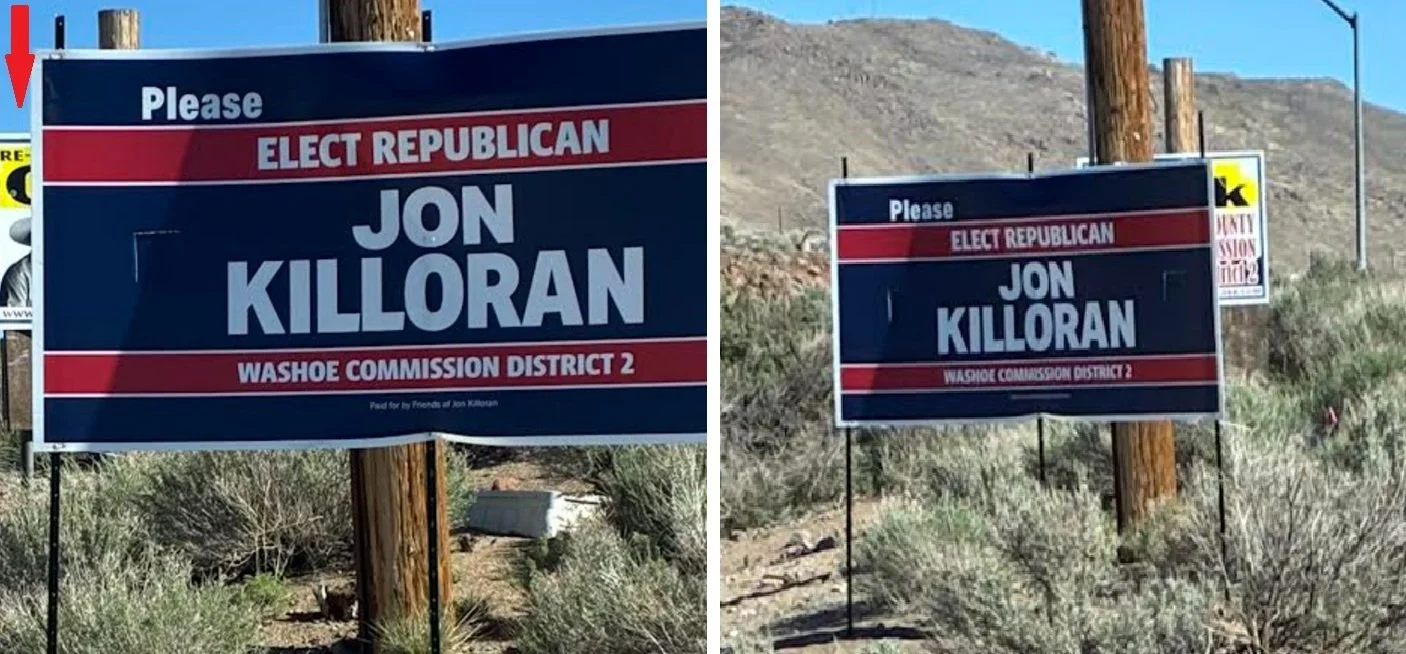
A reader sent us this ‘sign block’ - we were amused yet again because we’ve never seen a political sign that says “please” - a bit odd.
The campaign season always finds its rhythm eventually—but in Northern Nevada, one of the first drumbeats is almost always the same: sign wars.
Call it politics at street level. Call it territorial instinct dressed up in corrugated plastic. Or, if you’ve been around long enough, call it déjà vu.
Because here we are again.
Clark’s signs—once again—keep finding themselves blocked, boxed out, or just inconveniently overshadowed by an opponent’s placement. Not removed, not vandalized… just strategically made invisible. There’s an art to that. And, apparently, a tradition.
Ah yes, etiquette. Or the lack thereof.
Let’s rewind to 2022—the year many started paying closer attention to the chessboard behind the campaign trail. That was when then-Commissioner Bob Lucey managed to master the fine balance between aggressive sign placement and plausible deniability.
if there’s one thing even his critics will admit, it’s this: Clark is no amateur when it comes to sign placement. Far from it. The man is practically a field general of corrugated plastic. Since his first run for assessor, he’s built a reputation as one of the most prolific—and frankly effective—sign erectors in the region. If there’s a legal spot to hang it, zip-tie it, bolt it, or otherwise affix it, Clark will find it.
Overpasses, medians, fences, forgotten corners of high-traffic intersections—nothing escapes his radar. It’s not luck. It’s experience. And it’s persistence.
Back in 2022, during the primary Lucey didn’t “do” any of “that” - hanging signs, He had a team.
A team that handled placement. A team that handled strategy. A team that, conveniently, created just enough distance for him to shrug and say, “Must’ve been them.” It was a polished operation—no fingerprints, no fuss. And if there was a Clark sign the Lucey team tried to find a way to block it.
These days, Lucey has traded campaign signs for lobbying, landing at The Porter Group—a firm paid by the very county he once served. Not a bad landing spot. In fact, you might call it the kind of full-circle moment that only local politics can deliver.
But back to the present.
Enter Jon Killoran. Who seems to be following the Lucey-play-book.
Killoran bills himself as a media-savvy figure, a man who once floated the idea of bringing the Olympics to Nevada—a swing-for-the-fences kind of ambition. Which is why it feels… curious… that someone operating at that level would get tripped up by something as basic as campaign sign etiquette. He had to know this ‘hiding the other candidates sign” is just bad form.
Or maybe not.
Because, just like before, there’s always that buffer: “his people.”
It’s never the candidate. It’s the campaign. The volunteers. The mysterious overnight sign fairies who just happen to plant one sign directly in front of another with surgical precision.
Tacky? Maybe.
Predictable? Absolutely.
The truth is, sign wars aren’t really about visibility—they’re about message without words. Blocking a sign doesn’t just hide a name; it’s the political equivalent of marking territory, just with better fonts and disclaimers at the bottom.
And Mike Clark? When a reader sent us this photo and we reached out to him his comment was “I have more” - signs that is.
Because while candidates will talk about policy, leadership, and vision, the real story—at least in these early days—is playing out at intersections, medians, and dusty roadside patches across Washoe County.
No press releases. No debates.
Just signs.
And who’s blocking whom.