
Setting the Record Straight: Mike Clark Did His Job—Whether Critics Like It or Not
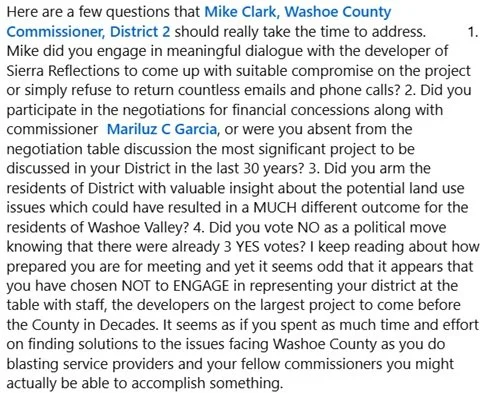
What was posted by a Jon Killoran supporter/donor on Facebook. We were amused. This individual has a clear agenda and that is to rid the world of Mike Clark since he didn’t vote for his project.
There’s a growing narrative being pushed that Washoe County Commissioner Mike Clark somehow failed to engage, failed to lead, or failed to represent his district on the Sierra Reflections project. It’s a nice talking point—but it doesn’t hold up under scrutiny.
Let’s walk through the accusations and deal in reality instead of rhetoric.
First—“Did Clark refuse to engage with the developer?”
This assumes that a commissioner’s job is to negotiate directly with developers behind the scenes. It’s not. Commissioners are decision-makers, not backroom dealmakers. Their role is to evaluate proposals in a public, transparent process—not broker private compromises over email or phone calls. Refusing to blur that line isn’t negligence—it’s adherence to good governance. It is questionable that Commissioner Mariluz Garcia did.
Second—“Was Clark absent from negotiations?”
Again, this misunderstands how the process works. County staff—not individual commissioners—handle negotiations, financial concessions, and project structuring. That’s by design. It prevents political favoritism and ensures a level playing field. Suggesting a commissioner should be directly negotiating raises more concerns than it answers.
Third—“Did he fail to inform residents?”
Anyone who’s actually followed Washoe County meetings knows that land use discussions, staff reports, and public comment periods are all part of an open process. Residents aren’t “armed” with information through one commissioner—they have access to agendas, documentation, and meetings. Clark’s role is to review that information, listen to constituents, and cast a vote accordingly—not act as a one-man communications department.
Fourth—“Was his ‘no’ vote political?”
This one’s especially convenient. When a commissioner votes “yes,” it’s called leadership. When they vote “no,” it’s suddenly “political.” Clark has a track record of independent decision-making, including being one of the few commissioners willing to take positions that aren’t always popular. Voting “no” when others are voting “yes” is the opposite of political safety—it’s a willingness to stand alone.
And here’s the part critics don’t want to acknowledge:
Commissioners are not elected to rubber-stamp projects or play nice in negotiations—they’re elected to exercise judgment.
Not every project deserves a compromise. Not every deal needs to be sweetened. And not every commissioner needs to fall in line.
The suggestion that Clark should spend less time criticizing and more time “accomplishing something” ignores a basic truth: sometimes the job is to ask hard questions, challenge assumptions, and yes—say no.
That’s not disengagement. That’s representation.
If anything, the real concern should be whether people are trying to redefine the role of a county commissioner into something it was never meant to be—an unelected negotiator operating behind closed doors.
Mike Clark didn’t fail to engage. He refused to play a role he wasn’t elected to fill.
And there’s a difference.