
Show Us the Rule, Your Honor
Stimulating reading …
We’ve been doing something radical lately: reading.
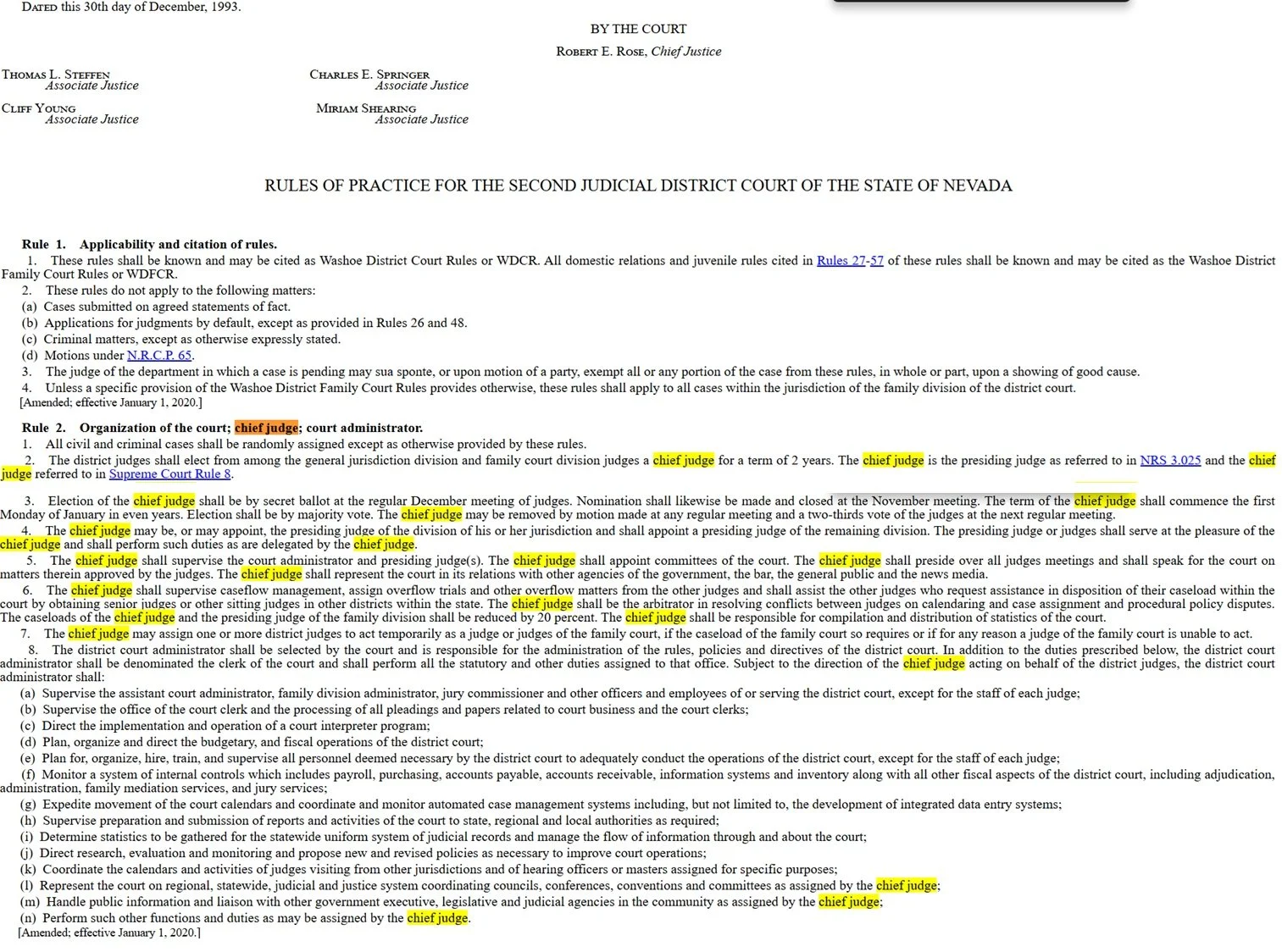
Yes, we dusted off the Rules of Practice for the Second Judicial District Court — you know, the thrilling bedside material governing how things actually work over at the courthouse. And we went straight to Rule 2, because that’s where the magic of the Chief Judge lives.
According to Rule 2, the Chief Judge of the Second Judicial District Court of Nevada is elected by fellow judges for a two-year term. The rule lays out supervisory duties, administrative authority, and the power to assign “overflow” trials and resolve conflicts between departments.
Overflow.
Conflicts.
Administration.
We read it. Twice.
What we did not find was a line that says:
“Chief Judge may remove an elected district court judge from her entire docket without explanation.”
Maybe we missed it. If so, someone please circle it in red and send it over.
Because here’s what we know:
Both Chief Judge Egan Walker and Judge Connie Steinheimer were elected by the voters of Washoe County. Not appointed. Not hired. Elected.
Judge Steinheimer has been on the bench since 1992. That’s more than three decades of judicial service. She is not new. She is not provisional. She is not in training.
Now compare that to what actual judicial misconduct looks like.
When former Washoe County Family Court Judge David Humke imploded his own career in 2019, it wasn’t done by administrative memo. It involved formal complaints, suspensions, and action by the Nevada Commission on Judicial Discipline. He ultimately resigned and was permanently barred from judicial office after admitted failures in managing cases and understanding family law.
That’s how removal for misconduct works.
It’s public.
It’s documented.
It involves findings.
So here’s the question echoing through the marble hallways:
Where is the misconduct?
If there isn’t any — and no public record suggests there is — then we’re not talking about discipline. We’re talking about administrative authority.
And yes, Rule 2 gives the Chief Judge supervisory control over case assignments. Courts can balance dockets. They can reassign overflow. They can manage calendars.
But removing an entire elected judge from all of her cases?
That’s not “overflow.” That’s a floodgate.
If this is simply administrative restructuring, then transparency should be easy. Produce the administrative order. Cite the subsection. Explain the operational necessity.
Because when one elected judge effectively sidelines another elected judge, the public deserves more than a shrug and a “trust us.”
This isn’t about personalities. It’s about process.
Judges are elected by voters — not by internal memo.
So again, respectfully:
Show us the rule.
Show us where it says a Chief Judge can wipe an elected judge’s docket clean.
If it’s there, we’ll read it.
We’re getting pretty good at that.