
A Safe Place to Park — But at What Cost?
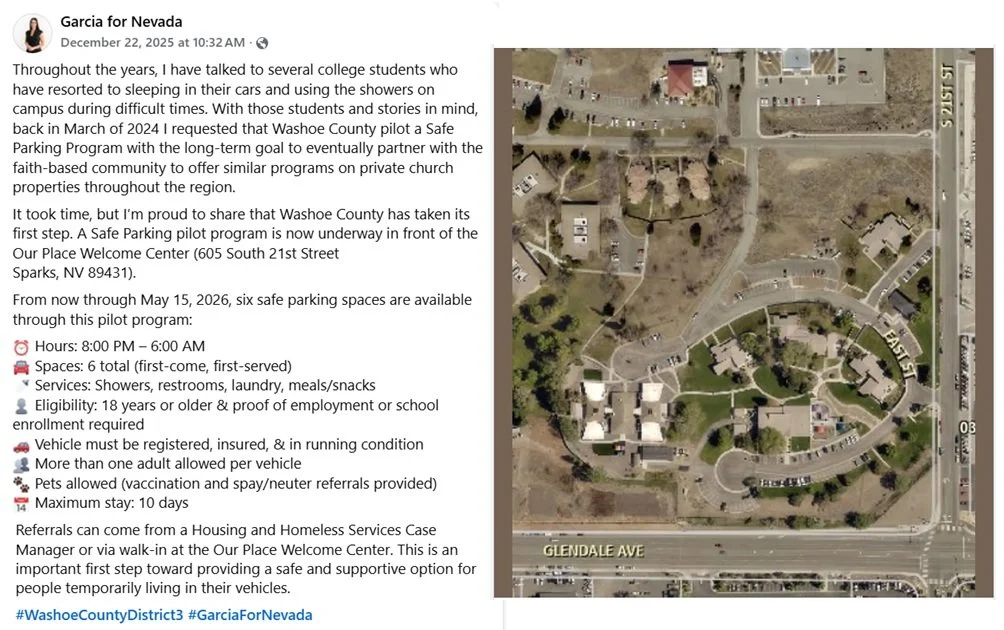
Commissioner Garcia’s post notes that more than one person is allowed in each vehicle under the new “safe parking” pilot. That raises a very basic — and very important — question: how is Washoe County verifying who else is in the car? Do additional occupants need ID? Are they screened in any way? Is there a limit on how many people can be in a single vehicle? When this program is placed on a campus serving women and children, transparency isn’t optional — it’s essential. If the county has answers, now would be a good time to share them.
Washoe County has launched a new pilot program allowing people living in their cars a place to park overnight at the Our Place campus in Sparks, billed as a compassionate response to homelessness. The program offers six first-come, first-served parking spaces through May 15, along with access to showers, restrooms, laundry, and meals.
On paper, it sounds humane.
In reality, it raises deeply troubling questions — especially about where this program is being placed and who may be put at risk.
A reader reached out to us calling the program “outrageous, absurd, and dangerous,” and after taking a closer look, it’s hard to dismiss those concerns.
Our Place is a facility specifically designed for women and children.
More than 60% of the women served there are fleeing domestic violence. The campus also includes a daycare facility and serves as a welcome and intake center for vulnerable women and children. It is, quite literally, one of the few spaces in the region built around safety, stability, and trauma-informed care.
So why would Washoe County place a vehicle-dwelling pilot program — involving unscreened individuals — on that campus?
Yes, there are eligibility requirements: vehicles must be registered and insured, individuals must be employed or enrolled in school, over 18, and have a valid driver’s license. But those criteria do not equate to background checks, nor do they address proximity concerns when it comes to children and survivors of abuse. And remember you can have more than one person in the vehicle … what is the identity/background check criteria.
Even more puzzling: Washoe County already operates the Nevada Cares Campus, which has cost taxpayers millions and includes extensive security infrastructure. Why not use parking spaces there? Or at one of the many county-owned parking lots that would not place this program directly next to a daycare and a women’s shelter?
These are not anti-compassion questions. They are basic safety questions.
Which leads to another issue: transparency.
Has the State of Nevada approved this program?
Is there a permit on record?
Does the Our Place lease allow this use?
Has daycare licensing signed off on having overnight vehicle dwellers on the same property?
Where is the documentation?
So far, the public has not been shown any of it.
Which brings us to leadership.
Has Washoe County Human Services Agency Executive Director Ryan Gustafson seriously weighed the risk to vulnerable women and children? Or has this pilot been pushed forward without fully considering its consequences?
And finally, timing matters.
This program quietly moves forward just as Commissioner Mariluz Garcia announces her reelection bid. County communications staff have been quick to place Garcia in front of media cameras, despite the fact that Commissioner Mike Clark has done far more public explaining of the program than Garcia herself. Was this initiative advanced to create a convenient “compassion headline” during campaign season?
If so, that should trouble everyone.
Our Place exists to protect women and children — not to serve as a testing ground for county pilot programs that could have been located elsewhere. Compassion should never come at the expense of safety, and politics should never come before vulnerable families.
Washoe County owes the public answers so we can all know Our Place remains a safe space.