
Devon Reese -Generation Inflation?
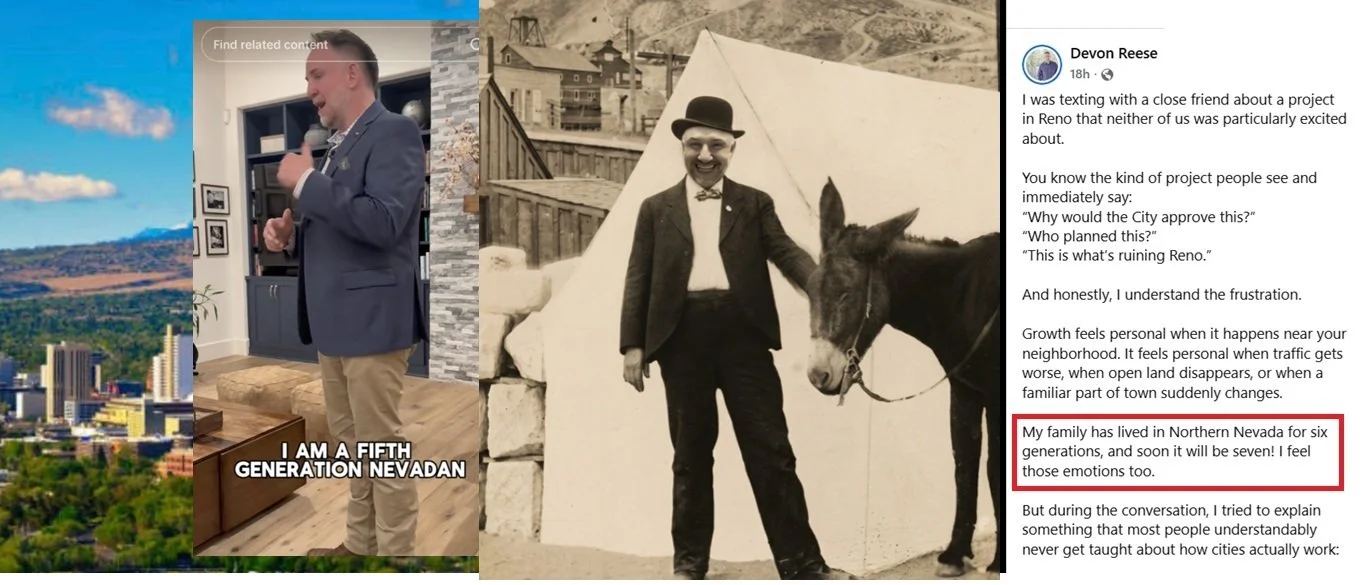
Fifth or Sixth … time to prove it
We ponder why Devon Reese keeps changed the number. First it was “5th generation Nevadan.” Now suddenly it’s “6th generation.”
So naturally people are asking: why does it matter so much?
Will adding another generation make him a better mayor?
Will it get more votes?
More likes on social media?
More trust from voters?
Because if family history has become a centerpiece of the campaign, then voters are probably entitled to ask for a little clarity — especially when the number changed.
A “6th generation Nevadan” would generally mean family roots in Nevada going back to the 1800s, around statehood or territorial days. That’s not a casual claim. That’s a specific historical timeline.
And honestly, this would be easy to clear up.
A census record.
A birth record.
An old family document.
Done.
Instead, voters are left wondering why the story evolved. Because when a campaign upgrades the label, people naturally start asking whether it’s biography… or branding.
If someone claims to be a “6th generation Nevadan,” it generally means they are the sixth generation of their family born or established in Nevada.
A rough generational timeline usually works like this:
1 generation = about 20–30 years
6 generations back = roughly 120–180 years
Since it’s 2026, that would typically mean the family first settled in Nevada somewhere around the mid-to-late 1800s — roughly between 1845 and 1905, depending on how the family counts generations.
More specifically:
If the candidate is around 40–60 years old today, their great-great-great-great-grandparents would likely have arrived during:
the silver boom era,
territorial days,
or shortly after Nevada became a state in 1864.
So for a modern politician to accurately claim “6th generation Nevadan,” you’d generally expect documented family roots in Nevada going back to the 1800s, not the mid-1900s.