
Selective Amnesia at the Dais: How a Vote to Criminalize Homelessness Became a Campaign Talking Point
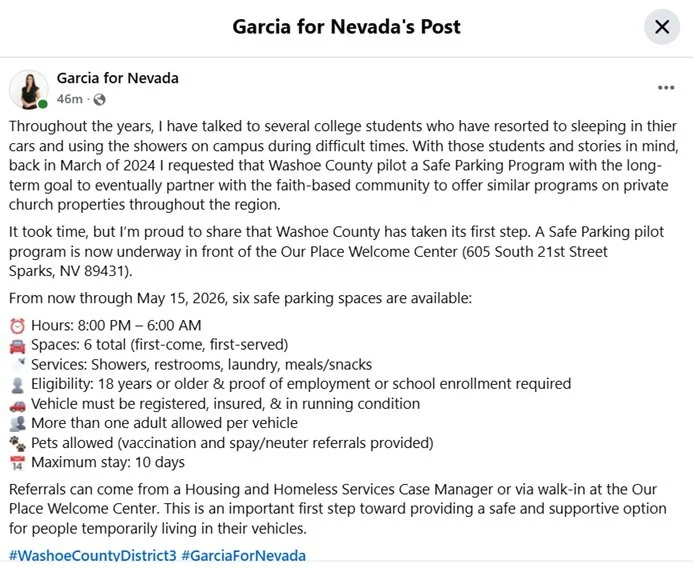
Commissioner Garcia is trying to rewrite history to her benefit.
Let’s rewind the tape.
In March 2024, Washoe County commissioners voted on an ordinance that effectively criminalized unhoused people for living in their cars. The split was clear — and telling.
Commissioners Mike Clark and Jeanne Herman voted NO, opposing criminalization.
Commissioners Mariluz Garcia, Alexis Hill, and Clara Andriola voted YES, supporting arrests and citations for people who are homeless.
Those votes are not a matter of opinion. They’re a matter of record.
Fast forward to today, and Commissioner Mariluz Garcia would very much like you to forget that vote. In fact, she’d like you to believe she has been — quote — working with Washoe County since that meeting on a Safe Parking Program, positioning herself as the driving force behind a more compassionate approach to vehicular homelessness.
There’s just one problem:
That’s not how it happened.
According to Nevada Current reporting from March 27, 2024, it was Commissioner Mike Clark who raised substantive concerns during the meeting — concerns that went well beyond rhetoric.
Clark questioned why the Public Defender’s Office wasn’t present, noting that any ordinance criminalizing homelessness would fall squarely on indigent defendants with no assets.
“It’s going to be the public defender and alternate public defender defending these people because they are indigent, because they are on the streets, and because they don’t have a house or any assets,” Clark said.
He went further, urging the county to pause and think before acting:
The public defender’s office needs “to weigh in on what we should be doing before we make a logical decision.”
Then came the policy idea — the one now being polished for Garcia’s campaign mailers.
Clark suggested designating specific parking lots where people living in their cars could safely sleep, provided vehicles were operational and drivers were licensed. He also raised the need for showers and portable toilets — actual infrastructure, not slogans.
Only after that did Commissioner Garcia weigh in, offering support for “potentially piloting a safe parking option,” noting vehicular homelessness as a service gap.
Supportive? Yes.
Originator? No.
The Nevada Current made it clear: Clark proposed it. Garcia supported it. No timeline was offered, no program launched, and no immediate follow-through occurred.
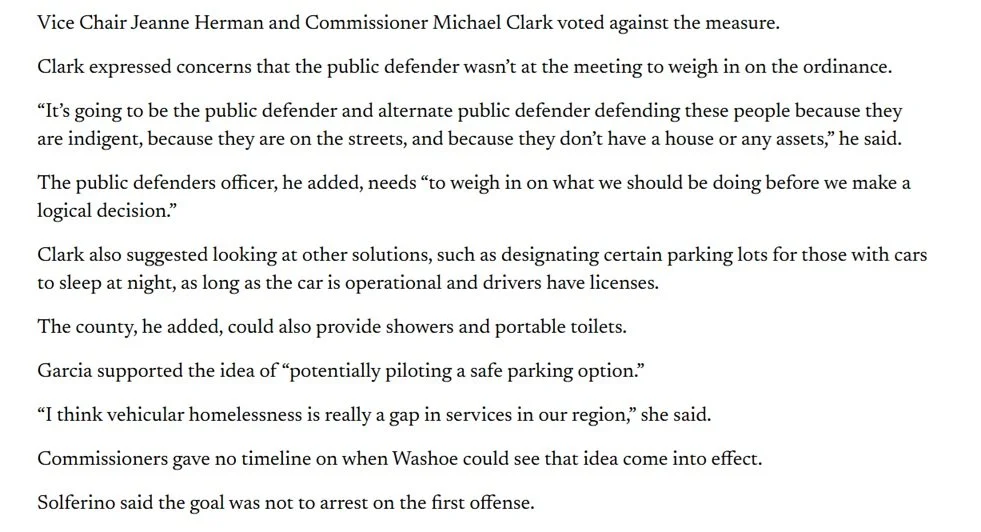
From the Nevada Current article in 2024.
Commissioner Clark told us he wasn’t surprised by how things unfolded.
“You’d think former County Manager Eric Brown would have worked with me on this, but that didn’t happen,” Clark said. “I was cut out early on, and around the same time Commissioner Garcia began having repeated issues with me. From that point, I could see where this was heading.”
Clark said each time he raised the idea of using county parking lots for a safe parking program, the response was telling.
“Whenever I brought up using county parking lots, staff would suddenly look at their feet or change the subject,” he said. “That made it pretty clear what was happening.”
In Clark’s view, the outcome was inevitable.
“Obviously, Manager Brown chose to move forward with Commissioner Garcia using my idea,” he said.
Which raises an uncomfortable but fair question:
Why is this idea now being branded as Garcia’s — and why does Clark seem to have been quietly written out of the narrative?
One possible explanation is timing. Garcia is now running for reelection, and “criminalized homelessness” doesn’t look great on a campaign résumé. “Safe parking champion,” on the other hand, polls much better.
So did Washoe County sideline the commissioner who voted against criminalization and floated the alternative — and hand the concept to a commissioner who voted for it, just in time for campaign season?
We’re not saying that’s what happened.
We’re just saying the timeline is awfully convenient.
Voters deserve honesty, not revisionist history. Supporting an idea after voting to criminalize the very people it would help is not leadership — it’s damage control.
And no amount of rebranding changes how that vote went down.