
When the Tape Is Fuzzy, Who Do You Believe?
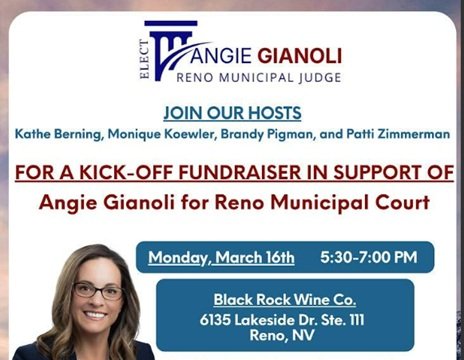
Everyone of a ‘certain age’ seem to be having their fundraisers at Black Rock Wine Co. We’re bored already.
Credit where it’s due: Mike’s Reno Report resurfaced an old municipal court case involving Angela Gianol — now a candidate for Reno Municipal Court Department 1 and currently a prosecutor in the criminal division of the Reno City Attorney's Office.
In that case, Gianol reportedly urged the court to rely on an undercover officer’s testimony rather than a difficult-to-hear audio recording.
That’s not gossip.
That’s jurisprudence.
Because here’s the real question for voters:
When objective evidence is unclear, how much weight should a judge give to officer testimony?
This isn’t about being “pro-police” or “anti-police.” It’s about standards of proof. Municipal court judges preside over cases where credibility, recordings, body cams, and officer narratives frequently collide. When evidence is imperfect — as it often is — the judge’s philosophy matters.
Should testimony fill the gaps?
Or should uncertainty benefit the defendant?
At the time, the case was decided by then-Municipal Court Judge Tammy Riggs (ever wonder how Tammy ran for that judicial seat all alone - no opponents - more on that later), and the matter was later reviewed and overturned by District Judge Kathleen Drakulich. Appeals exist for a reason. Higher courts sometimes disagree. That’s the system working (by the way, losing Judge Drakulich is a blow - she has ruled impartially and fairly over the years).
But campaigns are about more than résumés. They’re about judgment.
Gianol’s background is prosecutorial. That’s not disqualifying — many fine judges come from prosecution. But when a candidate has argued that a court should prioritize testimony over a flawed recording, voters are entitled to ask how she views evidentiary conflicts today.
Has her perspective evolved?
How does she balance deference to law enforcement with the burden of proof?
Where does she draw the line when the evidence isn’t crystal clear?
Those are legitimate questions for any judicial forum, fundraiser, or debate.
Judges aren’t policymakers. They are referees. And referees must convince the public they will call the game based on the evidence — even when the evidence is messy.
The robe requires independence.
The bench requires balance.
And voters deserve clarity about both.
If the tape is fuzzy, who do you believe?
That’s not an attack.
That’s an election question.